⚡ LIVE — Free AI Visibility Audit, AEO & GEO Checker — 2026
#1 Free Alternative to SEMrush for AI Search Visibility

Free AI Visibility Audit —Is AI Recommending You?

The free AI visibility audit tool built for 2026. Instantly check your AI search rankingacross ChatGPT, Gemini, Perplexity & Claude with a free 8-signal AEO & GEO audit — no signup, no credit card.

GPT-4o
Gemini
Perplexity
Claude

100% Free · No signup, no credit card required · Unlimited audits ready

8Signals
Scanned Per Audit
4AI Engines
GPT · Gemini · Claude · Perplexity
InstantAnalysis
Full report in ~15 seconds
100%Free
No Card · No Signup
GPT-4o Search Index
✓ LEGAL & VALID
🔍

From URL to AI Visibility Score in 20–35 Seconds

No signup. No credit card. No bloated dashboard. VisibilityPulse delivers a complete AI visibility audit faster than Semrush, Ahrefs, or Moz — and it’s 100% free. See exactly why AI engines skip your site and get a prioritised fix plan.

Enter Any Website URL

Paste any domain. No login, no credit card. Our streaming audit engine launches the full audit immediately — and begins delivering results as each signal resolves in real time.

ZERO SIGNUP

Parallel Live Data Fetch

Your page, robots.txt, sitemap, Wikipedia, Wikidata, Chrome UX Report, PageSpeed Insights, and 8 sampled links are fetched simultaneously. Each resolves independently — no blocking, no fake waits.

5 PARALLEL STREAMS

Get Your AI Visibility Score

A 0–100 composite score across 5 weighted signals (AI Crawlers 20%, Schema 25%, Entity 25%, Technical+CWV 20%, Freshness 10%) — with an AI Optimizer playbook that prioritises only verified, actionable fixes.

REAL RESULTS

Execute the Optimizer Playbook

Follow the ranked fix list derived from your actual audit data. Every recommendation is backed by a real signal reading from your site — no generic advice, no invented scores.

DATA-BACKED FIXES
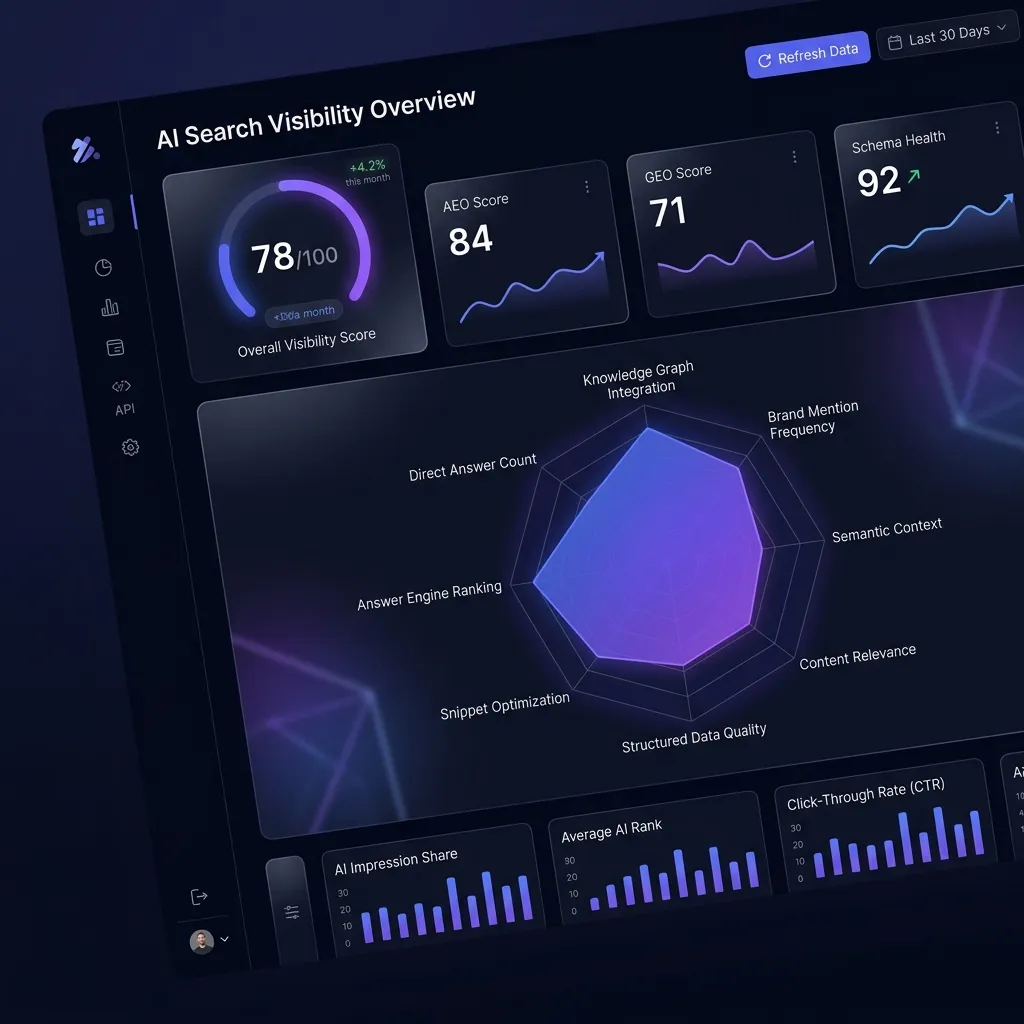
VisibilityPulse live audit results — AI search visibility score dashboard
Live Audit Results — VisibilityPulse DashboardTry It Free →

The GEO Playbook

Battle-tested tactics to increase AI search citations

LIVE UPDATED
Fix JSON-LD Schema — Organization + Speakable

Add Organization schema with name, url, logo, and sameAs links. Add Speakable schema (SpeakableSpecification) to enable voice search and text-to-speech citations. Note: Google deprecated FAQPage rich results on May 7, 2026 — FAQPage now primarily helps knowledge graphs, while Speakable and structured data tables are the active paths for voice/search AI.

Publish Freshness Signals for AI Recency Boost

AI models strongly prefer recently updated sources. Add datePublished and dateModified to your JSON-LD. The audit checks both schema dates and sitemap lastmod and reports whichever is most recent as the authoritative date.

Build Entity Authority (Wikipedia, Wikidata, sameAs)

AI engines verify brand legitimacy through entity graphs. Wikipedia and Wikidata entries are checked via live API calls. sameAs links to LinkedIn, Crunchbase, and Wikipedia each contribute up to 5 points to the Entity signal.

Unblock AI Citation Crawlers in robots.txt

OAI-SearchBot (ChatGPT Search), PerplexityBot, Claude-SearchBot, and Bingbot drive live AI citations — not GPTBot, ClaudeBot, or Google-Extended, which are training-only bots. Blocking citation crawlers directly prevents AI engines from referencing your content.

Run a Free AI Visibility Checker

Enter any website URL. Our streaming audit engine checks every signal in real time — no fake progress bars, no fabricated scores. Results are backed by live data only.

INITIALIZING AUDIT ENGINE v3...

Every Signal AI Engines Use to Rank You

Our 8-signal audit engine is purpose-built for the generative AI era — auditing signals that SEMrush, Ahrefs, and Moz don’t even track yet. Each signal maps directly to ranking factors used by ChatGPT, Gemini, Perplexity and Claude when selecting sources to cite.

AEO & GEO Optimization

Measures your content structure against what Answer Engine Optimization (AEO) requires. Checks statistical citation density (tables, lists, metrics), question-intent formatting, and fact-density — exactly what SEMrush’s Content Score misses.

AEO AUDIT

International & Social Discoverability

Checks Open Graph tags (og:title, og:description, og:image), Twitter Cards, hreflang presence, lang attribute, and canonical tags. These signals control how your brand appears across international AI engines and social platforms.

SOCIAL SIGNALS

JSON-LD Schema Markup Audit

Validates JSON-LD structured data: SpeakableSpecification, Organization, Article, BreadcrumbList, Person. Note: Google deprecated FAQPage rich results on May 7, 2026 — Speakable schema now primarily handles voice search and LLM extraction.

25% WEIGHT

Entity Authority & Knowledge Graph

Measures your brand as a recognized entity via Wikipedia and Wikidata APIs. sameAs authority links pointing to high-authority nodes like LinkedIn, Wikipedia, Crunchbase, Reddit, YouTube, G2, and Clutch score independently.

25% WEIGHT

Technical SEO & Core Web Vitals

Full technical audit: HTTPS, LCP, CLS, INP via Google PageSpeed Insights, msvalidate.01 validation meta tag, H1 structure, canonical tags, and security headers (HSTS, CSP, X-Frame). Highly critical for AI citations.

20% WEIGHT

Content Freshness & Recency

AI models strongly prefer recently updated sources. Checks Last-Modified headers, datePublished/dateModified schema, sitemap lastmod, and content update frequency — signals ignored by traditional keyword-rank tools.

10% WEIGHT

AI Citation Crawler Access

Checks 10 citation crawlers in robots.txt: OAI-SearchBot, PerplexityBot, Claude-SearchBot, Bingbot, Amazonbot, Applebot-Extended, DuckAssistBot, MistralAI-User, Google-CloudVertexBot, and Google-NotebookLM. GPTBot, ClaudeBot, FacebookBot, and Google-Extended are training-only (opt-out).

20% WEIGHT

E-E-A-T & Author Credibility

Checks Experience, Expertise, Authoritativeness, and Trustworthiness signals: author bios, bylines, About pages, outbound links to authoritative sources, and brand citation anchors. Critical for Google AI Overviews.

E-E-A-T AUDIT
The Ultimate AEO Checker & GEO Optimization Tool

Traditional SEO tools weren't designed for LLM citation engines. VisibilityPulse was built specifically for Answer Engine Optimization and Generative Engine Optimization.

Feature ComparisonUpdated June 2026
FeatureVisibilityPulse(Free)Semrush$139–$499/moPeec AI / Otterly$49–$299/mo
AI Crawler Access Check (GPTBot, ClaudeBot, Perplexity)Partial
Core Web Vitals via Google PSI (LCP, CLS, INP)Partial
JSON-LD Schema Markup ValidationPartial
Real-time AEO / AI Visibility Score
GEO Regional Visibility Mapping
E-E-A-T Deep Signal AuditPartial
Entity Authority & Wikipedia CheckPartial
llms.txt AI Guidance File Detection
Security Headers Audit (HSTS, CSP, X-Frame)
AI Optimizer Action PlaybookPartialPartial
Backlink Mapping (Coming Soon)Partial
100% Free — No Credit Card Required
No Account / No Signup Needed
Instant Results (under 15 seconds)Partial
International hreflang Validation
VisibilityPulse is the only tool built natively for AI-era search visibility — 100% free.

* Disclaimer: SEMRUSH® is a registered trademark of Semrush Technologies Inc. Peec AI is a registered trademark of its respective owner. VisibilityPulse is an independent audit tool with no official affiliation, partnership, sponsorship, or endorsement with Semrush, Peec AI, Otterly, or any other trademarked platforms. Comparative findings represent publicly available feature information as of June 2026 and are provided for informational purposes only.

AI Search Is Rewriting Discovery

Every stat below is sourced. No invented adoption rates.

0.664

Brand mentions correlation with AI citation probability

Source: Ahrefs, 75K brands, May 2025

vs 0.218 for backlinks — off-site brand presence outperforms links

1.4%

Cross-platform citation URL overlap (ChatGPT, Perplexity, Claude, Gemini)

Source: Lee, 2026 — 19,556 queries

Each AI engine cites differently. Optimise per-engine, not for a single universal score.

Still SEO

Google's official position on AEO/GEO (May 2026)

Source: Google Search Central, May 15 2026

"Optimizing for generative AI is still SEO" — AI features use the same core ranking systems.

3 Crawlers

OpenAI crawlers — each with a distinct role

Source: platform.openai.com/docs/bots

OAI-SearchBot (citations), GPTBot (training), ChatGPT-User (real-time). Most guides only mention GPTBot.

AI Search Optimization Playbooks & Guides

Master Answer Engine Optimization and Generative Engine Optimization with expert guides on AI search ranking, schema markup, and entity authority.

ChatGPT SEO8 min read

How to Get Your Business Cited by ChatGPT in 2026

Step-by-step guide to allowing GPTBot, adding FAQPage schema, writing direct answer-format content, and building entity authority so ChatGPT, Gemini, and Perplexity cite your site.

11 Jun 2026Read Article →
Tool Comparison6 min read

Free Semrush Alternative for AI Search Visibility

Semrush costs $139/month and has limited AI features. VisibilityPulse is 100% free, no signup, and provides a deeper 8-signal audit for ChatGPT, Gemini, Perplexity & Claude.

11 Jun 2026Read Article →
AEO vs SEO9 min read

AEO vs SEO vs GEO: The Complete 2026 Guide

Search has split into three disciplines in 2026. Understand the difference between Answer Engine Optimization, traditional SEO, and Generative Engine Optimization — and which to prioritize.

11 Jun 2026Read Article →
Technical SEO5 min read

GPTBot robots.txt: Complete Setup Guide for AI Crawlers

Is your robots.txt blocking ChatGPT, ClaudeBot, and PerplexityBot? Complete setup guide with copy-paste configuration for all major AI crawlers to index your site.

11 Jun 2026Read Article →
Google AI Overview7 min read

How to Appear in Google AI Overviews: 2026 Guide

Step-by-step guide to getting cited in Google AI Overviews. Covers schema, E-E-A-T, Google-Extended robots.txt, Core Web Vitals, and the 40-60 word direct answer rule.

11 Jun 2026Read Article →
GEO Optimization6 min read

The GEO Playbook: Optimizing for AI Search Engines

How ChatGPT, Gemini, and Perplexity index and cite content. Learn the five core pillars of Generative Engine Optimisation to secure your citations.

28 May 2026Read Article →
Structured Data5 min read

Why Schema Markup Matters for AI Citation Eligibility

Large Language Models rely heavily on structured JSON-LD data. Discover why FAQPage and Organization schemas are critical for AI visibility.

02 Jun 2026Read Article →
E-E-A-T & Authority7 min read

E-E-A-T and Entity SEO in the Era of AI Search

How search entities are mapped in LLM knowledge graphs. Learn how to build topical authority and author credentials that AI bots verify.

04 Jun 2026Read Article →
View All AI SEO Insights →

Engine Guidelines & Web Standards

We compile and audit your metadata against citation criteria established by leading AI research labs and open web bodies.

Schema.org standards

The official semantic vocabulary for structured JSON-LD data graphs.

schema.org
Google search central

Official documentation for AI overviews, crawlers, and structured data.

developers.google.com
OpenAI crawler rules

Crawler directives for GPTBot agent configuration and scraping constraints.

openai.com
Anthropic scraper guidelines

Crawler directives for User-Agent ClaudeBot rules.

anthropic.com
Perplexity indexer details

Directives for PerplexityBot, mapping how citation indexing works.

perplexity.ai
W3C structured web

The global standardizer for HTML5 semantic parsing rules.

w3.org

AI Visibility Audit Questions Answered

Everything you need to know about AI visibility audits, AEO, GEO, how to rank in ChatGPT, Gemini & Perplexity — and why VisibilityPulse beats Semrush for AI search.

AI visibility measures how often and how prominently your brand, products, or website appear in AI-generated answers from ChatGPT, Google Gemini, Perplexity, and Claude. In 2026, AI answer engines are replacing traditional search results for millions of queries. If AI cannot find, understand, or trust your website — you are invisible to a growing share of your potential customers.
AEO — Answer Engine Optimisation — is the practice of structuring your website content, metadata, and schema markup so that AI answer engines cite your pages in their generated responses. Unlike traditional SEO which optimises for click-through rates, AEO optimises for citation frequency. FAQPage JSON-LD schema, Organization markup, and clear entity signals are the highest-impact AEO tactics.
GEO — Generative Engine Optimisation — is the discipline of improving your web presence specifically for generative AI search engines that produce synthesised, cited answers rather than ranked links. GEO involves strengthening entity authority, freshness signals, E-E-A-T credentials, and ensuring AI crawlers like GPTBot, ClaudeBot, and PerplexityBot have unrestricted access to your content.
To get cited by ChatGPT, you need to: (1) Allow OAI-SearchBot in your robots.txt file — if blocked, ChatGPT Search cannot read your site. (2) Add structured JSON-LD Organization schema markup to your homepage. (3) Publish clear, concise answer-style content that directly responds to questions your customers ask. (4) Build entity authority by getting mentions on authoritative third-party sites, directories, and Wikipedia. VisibilityPulse's free AI audit checks all of these signals and tells you exactly what to fix.
Google AI Overviews prioritises pages with strong E-E-A-T signals, clear structured data, and high statistical citation density (tables, lists, metrics). To appear: add Article and structured schema markup, include author credentials and publication dates, write content that directly answers common questions in 40–60 words, and maintain HTTPS with fast load times. Run a free VisibilityPulse audit to check your Google AI Overview readiness score instantly.
VisibilityPulse audits your AI search visibility across the major AI search systems: ChatGPT Search (via OAI-SearchBot), Perplexity AI (via PerplexityBot), Anthropic Claude (via Claude-SearchBot), and Bing/Copilot (via Bingbot). We also check Gemini training-grounding directives (Google-Extended) and secondary crawlers.
Semrush and Ahrefs were built for Google's traditional blue-link algorithm — they track keyword rankings, backlinks, and domain authority. VisibilityPulse was built specifically for the AI search era. We measure AI citation eligibility: statistical citation density, schema compliance, crawler access, entity graph strength, E-E-A-T trust signals, and content freshness. Semrush's AI toolkit is a basic bolt-on that costs $139+/month. VisibilityPulse delivers deeper AI-specific insights — 100% free, no signup required.
Yes — VisibilityPulse is the best free alternative to Semrush, Ahrefs, Georion, and Peec AI specifically for AI search visibility auditing. While Semrush costs $139+/month and Georion starts at $69/month, VisibilityPulse provides a deeper 8-signal AI audit for free, with no account required. It is the only tool that combines AEO readiness, GEO visibility, entity authority, schema validation, crawler access checks, and E-E-A-T signals in one free audit.
We recommend running a full AI visibility audit at least once per month, and immediately after major website changes (redesigns, new pages, or schema edits). AI engines update their indexes frequently. Key signals like content freshness, schema validity, and crawler access rules can change with every site update. Monthly auditing ensures you maintain and improve your AI citation rate.
Yes — 100% free. No account required. No credit card. No hidden limits. VisibilityPulse was built by DigiSyndicate Global to democratise AI search optimisation, making enterprise-grade AEO and GEO auditing accessible to every business — from solo founders to global brands. Run unlimited audits on any URL at zero cost.
Yes — VisibilityPulse works for any local business: restaurants, clinics, law firms, real estate agents, salons, gyms. When a customer asks ChatGPT or Gemini "best dentist near me" or "top restaurant in [city]", AI pulls from websites with strong entity authority, Google Business signals, and schema markup. VisibilityPulse's audit identifies exactly which local AI signals are missing and ranks them by priority.
Absolutely. Marketing agencies and SEO consultants use VisibilityPulse to audit client websites in seconds and generate AI visibility scores for pitch decks and monthly reports. Since there is no login required, you can audit any client URL instantly. The 8-signal breakdown with per-signal scores and AI Optimizer recommendations gives you a ready-made action plan to present to clients.
Entity Authority measures how well-recognised your brand is as a real-world entity in AI knowledge graphs. AI engines like ChatGPT and Gemini are trained on vast datasets — brands with Wikipedia entries, structured citations in authoritative directories, consistent NAP (Name, Address, Phone) data across the web, and mentions in high-authority publications rank significantly higher in entity recognition. Globally known brands like Infosys or TCS score high on entity authority regardless of their on-page technical signals.
VisibilityPulse measures two dimensions: Technical AI Optimisation (schema, crawlers, meta signals on your website) and Entity Authority (how recognised your brand is to AI engines from external signals). A globally recognised brand like Infosys has extreme entity authority from decades of media coverage, Wikipedia, and authoritative citations. Even if their technical signals are imperfect, their entity authority ensures AI engines recommend them. A new startup must focus heavily on technical optimisation to compensate for lower entity authority — and VisibilityPulse shows exactly how.
A+ (90–100) = AI Champion — AI engines actively cite you. A (80–89) = Highly Visible — Strong citation likelihood. B+ (70–79) = Competitive — Good foundation, some gaps. B (60–69) = Growing — Moderate visibility, clear improvement path. C (50–59) = Needs Work — Missing key signals. D (40–49) = At Risk — Significant gaps across multiple signals. F (below 40) = Invisible — AI engines cannot properly process your site.
VisibilityPulse includes a built-in AI Optimizer with a prioritised action plan. The highest-impact fixes are: (1) Add FAQPage JSON-LD schema — structures content for AI extraction and strengthens Knowledge Graph signals. (2) Allow GPTBot, ClaudeBot, and PerplexityBot in robots.txt — critical for AI crawl access. (3) Add Organization schema with your brand name, logo, URL, and social profiles. (4) Update content within the last 30 days with a visible publication date for freshness signals. (5) Add an author bio with credentials. (6) Get cited on Wikipedia, Crunchbase, LinkedIn, and industry directories to build entity authority.
VisibilityPulse is the best free AI SEO tool in 2026. It provides a complete 8-signal AI visibility audit covering GPTBot access, JSON-LD schema, Core Web Vitals, E-E-A-T signals, entity authority, content freshness, and more — all at zero cost with no account required. Unlike paid tools such as Semrush ($139+/month) or Peec AI ($49+/month), VisibilityPulse delivers deeper AI-specific insights built natively for the ChatGPT, Gemini, and Perplexity era.
You cannot directly query ChatGPT's index, but you can check the technical prerequisites that determine whether ChatGPT will cite your site: (1) Run a VisibilityPulse AI audit to check if GPTBot is allowed in your robots.txt. (2) Verify your JSON-LD structured data (especially FAQPage and Organization schema) is correctly implemented. (3) Check that your page loads in under 2.5 seconds (LCP). (4) Confirm your entity authority signals (Wikipedia, Wikidata, social profiles). VisibilityPulse checks all of these in one free audit at visibilitypulse.online.
An AI visibility score (0–100) measures how likely AI answer engines — ChatGPT, Gemini, Perplexity, and Claude — are to crawl, understand, trust, and cite your website. VisibilityPulse calculates it across 8 signals: 5 weighted signals (technical health [30%], entity authority [25%], content freshness [15%], AI crawler access [15%], and schema markup [15%]) plus 3 qualitative diagnostic flags (AEO readiness, GEO optimization, and E-E-A-T credentials). A score above 75 indicates strong AI citation likelihood. Scores below 40 indicate critical gaps.
Perplexity AI crawls the web using PerplexityBot (identifiable by its user agent in your server logs). It prioritises pages that: (1) Allow PerplexityBot in robots.txt — blocked sites are never cited. (2) Have clear, structured answers directly addressing specific questions. (3) Include JSON-LD structured data signalling content type. (4) Load quickly (LCP under 2.5 seconds). (5) Have strong entity authority signals (Organisation schema, Wikipedia/Wikidata mentions). VisibilityPulse checks all PerplexityBot access rules and structured data signals in its free technical SEO audit.
For AI search visibility specifically, yes — VisibilityPulse outperforms Semrush significantly. Semrush was built for Google's traditional keyword-ranking algorithm and has only basic AI features bolted on. VisibilityPulse was built from scratch for the AI search era. Key advantages: (1) VisibilityPulse is 100% free vs. Semrush at $139–$499/month. (2) VisibilityPulse checks GPTBot, ClaudeBot, and PerplexityBot access — Semrush does not. (3) VisibilityPulse audits llms.txt, entity authority via Wikipedia/Wikidata, and AI crawler directives — all unavailable in Semrush. For traditional keyword research and backlink analysis, Semrush remains strong. For AI citation readiness, VisibilityPulse is the superior choice.
Run Your Free AI Visibility Audit →Free · No Signup · Results in ~15 seconds · No credit card